
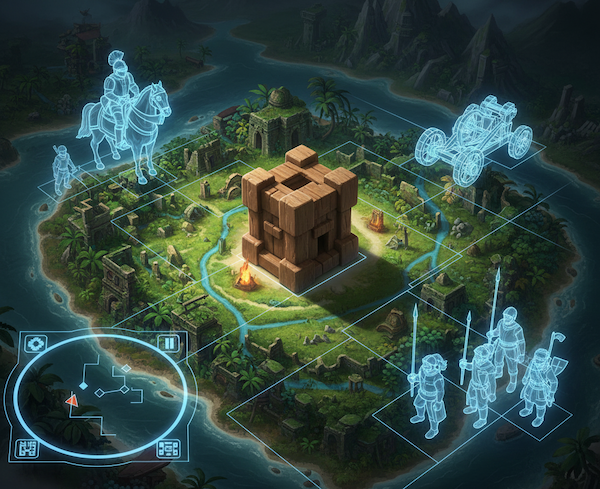
The “Systems-Thinker” Crossover: Digital Empire Builders Meet Analog Strategy. You spent countless hours commanding villagers, researching technologies, and watching your Feudal Age town blossom into an unstoppable Imperial force in Age of Empires (AoE) Definitive Edition or Command & Conquer.
You know the satisfaction of executing a perfect “Fast Castle” build or balancing your resources under pressure. Now, your “systems-thinker” brain is looking for a new, tactile challenge—one you can touch, feel, and share with friends around a table.
The move from Real-Time Strategy (RTS) PC gaming to complex, modern tabletop games isn’t a transition; it’s a natural next step. Both hobbies satisfy a core psychographic: the love of learning, mastering, and engaging with complex, interlocking systems. You love “empire-building” and “world domination”, and we’ve found the perfect next challenge for your shelf: the highly acclaimed cooperative powerhouse, Spirit Island.
Why Spirit Island Appeals to the RTS Brain
Spirit Island is a cooperative “area control” board game where players take on the role of powerful nature spirits defending an island from colonizing Invaders. It’s a “systems-mastery” experience that hits all the strategic notes that make AoE and C&C so compelling.
Strategic Resource Management (The Feudal Age Build-Up)
In Age of Empires, you manage key resources like Wood, Food, and Gold. In Spirit Island, your economy is built around Energy (the currency for playing powerful cards) and Presence (your area of control, which expands your reach and unlocks more powerful abilities).
Mismanage your opening build order (your turn sequence and Presence placement), and the Invaders will quickly overwhelm your nascent power. Like any great RTS, Spirit Island’s economy requires you to out-build and out-maneuver your opponent—in this case, the relentless Invader deck.
The Predictive Defense Loop
The core challenge of Spirit Island is its cyclical, predictable threat: Invaders Explore, Build, and then Ravage in a fixed, recurring order. This predictive pattern is familiar to any seasoned RTS player who plans their defenses around enemy build times and choke points.
Your spirits act like specialized, asymmetric factions, much like the different civilizations in AoE. One spirit might focus on rapid expansion and Energy generation (a “booming” economic build), while another focuses on massive, concentrated area damage (a “turtling” defense with siege units). The entire game becomes a constant cycle of crisis management and damage control to prevent the land from being “blighted” and ruined.
Non-Obvious Unit Synergy (The Tech Tree)
In AoE, combining Archers, Pikemen, and a Monk creates a powerful synergy that is greater than the sum of its parts. Spirit Island’s Power Card system is your tech tree, and it’s where the “systems-thinker” brain truly shines.
The fun lies in discovering and mastering the interlocking systems of your spirits and your teammates. One spirit might use a low-cost power to “gather” Invaders into a single area (like a lure), setting up another spirit to follow up with a massive elemental power that destroys the entire cluster. This constant, high-stakes coordination and execution of a joint strategic plan will feel instantly rewarding to any player who loves mastering complex rules and systems.
The Collector’s Journey: From Pixel to Component
This crossover content is the “Aha! Moment” for the Passionate Curator. By moving from the digital world of RTS gaming to the physical world of tabletop strategy, you are elevating your hobby.
The same “systems-thinker” brain that enjoys building and programming the complex, interlocking systems of a Lego Mindstorms robot or learning the complex lore and rules of a Curse of Strahd D&D adventure, is the perfect audience for Spirit Island. The person who searches for Curse of Strahd is, in fact, the perfect target, as they are a proven systems-thinker, a narrative-lover, and a collector.
This connection successfully bridges The Digital Nexus (Pillar 3) to The Modern Tabletop Gamer (Pillar 1B), leading the enthusiast toward higher-margin, analog purchases.
If you enjoy the strategic resource management of your classic PC games, you will appreciate the deep, high-quality components of games like Spirit Island. This is where the Value for Tactile & Analog Media—the preference for the weight of high-quality board game components—comes into play.
Conclusion: Level Up Your Analog Hobby
As a “Modern Curator,” you don’t just consume—you master. The intellectual and strategic foundation you built playing Age of Empires and Command & Conquer is the perfect blueprint for diving into complex, heavy board games like Spirit Island.
The game is highly replayable, offers deep tactics, and comes with customizable difficulty options, ensuring hundreds of hours of satisfying strategic mastery. Stop crushing virtual AI armies and start crushing the analog game: your curated shelf awaits.